Blog

Jazz Leadership

Developing A Performance Culture

By Dr Mark Powell and Jonathan Gifford

This post is the fourth in a series of five articles describing a major arts-based leadership development programme at Oxford University’s Saïd Business School, designed and run over a four-year period by Dr Mark Powell, one of the authors of this article.

Read the previous article: ‘Turning Businesses Into Ensembles’

The aim was to create a new culture of ‘open mindedness’ among the senior project managers of a UK oil and gas exploration company, encouraging them to interact more effectively with the other stakeholders in their capital projects and enhancing their ability to improvise in the face of rapidly changing situations.

The programme was designed to give delegates a series of ‘up close and personal’ encounters with performing artists. As Dr Powell says: ‘Having spent so many years running leadership programmes, I came to the conclusion that the things that really stick with people have two things in common. One is that they are experiential; the things that can actually change leaders’ behaviour tend to be real experiences, not some new piece of theory. The second thing I found is that leaders are more open to learning if they are presented with something from an unfamiliar context. People react defensively to new ideas in areas where they feel they are already pretty expert. But put them in front of jazz musicians or actors, and they accept that these people know stuff that they don’t know. They acknowledge that they may have something to learn from this encounter.’

And all that jazz

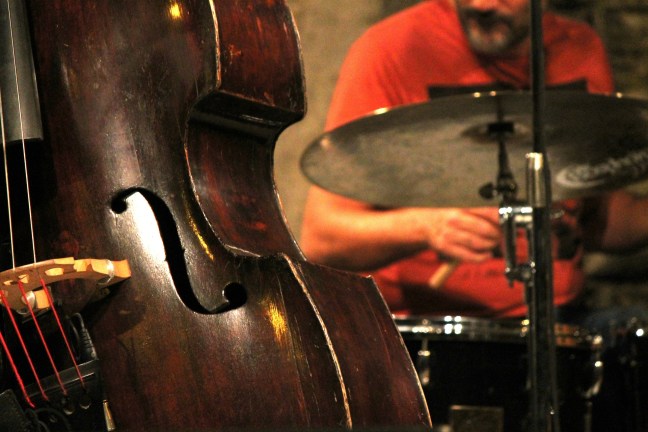
This article focusses on the jazz-based sessions of the programme. These were facilitated by Dr Powell, using a group of musicians assembled for the day by a professional jazz trumpeter. The fact that the band was assembled ‘from scratch’ with players who happened to be available on the day helped to reinforce the fact that experienced jazz musicians are able to perform to a remarkably high standard without rehearsal.

“Life is a lot like Jazz – it’s best when you improvise.” George Gershwin

The structure of the jazz-based workshops was simple: the musicians played a few pieces with a high improvisational content; the delegates watched and listened and after each piece there was a discussion about what the musicians were doing and experiencing and about the experience of the ‘audience’. The closeness of the delegates to the musicians was crucial. Being only a few feet away from the performers brought the delegates into the performance; they could see the performers’ expressions and sense the interaction between them.

Mastery allows improvisation

Jazz is a rich field to explore in the context of organisational culture. There is only space in this article to cover some of the key ‘take-outs’ from a typical session.

The first reaction of many delegates was to question whether what they had just heard could possibly have been created mainly in the moment rather than rehearsed: the musicians’ improvisational skills are startling.

Delegates were intrigued by the way in which the musicians’ mastery allowed them great freedoms: their grasp of the underlying musical structures and their instrumental virtuosity gave them the ability to ‘feel’ what to play at any moment and, in effect, to innovate constantly.

“Never play anything the same way twice.” Louis Armstrong

Delegates considered and discussed the extent to which this was possible in the business world. ‘Mastery of one’s brief’ was seen as a possible equivalent with the consequent ability to make quick and successful decisions. In more technical fields, delegates talked about how real ‘masters’ were able to see or ‘feel’ possible solutions before they could articulate the whole process.

Moving leadership around the ensemble

Delegates were also intrigued by the ability of an apparently ‘leaderless’ ensemble to behave in such a complex and coordinated way. Discussion centred on how leadership was effectively passed around the ensemble, with each player being empowered to take the piece in a new direction, while the musicians’ intense focus on each other’s performance allowed them to respond instantly to the offered suggestions. These shifting leaders can be described as being temporarily ‘in charge, but not in control,’ a concept that was also developed in the drama sessions of this programme.

Subsuming individual performances to the whole

Delegates also noted how individual performances were subsumed to the overall performance. When a player took a solo, the rest of band dedicated their efforts to supporting them, picking up on new directions and offering their own rhythmic or tonal suggestions as inspiration. The soloists themselves were clearly working with the band to deliver a satisfying overall performance, rather than simply ‘showing off’.

The musicians demonstrated what happened when they focused only on their own performance and stopped supporting each other’s performance – the music quickly degenerated into blandness or cacophony.

This concept was similar to the one explored in the dance-related workshops in the programme, where dancers demonstrate what happens when the allowed leadership in a dance partnership degenerates into ‘push-pull’ – the dance immediately loses its grace.

Harnessing the energy of individual egos

It also tended to strike delegates that people in business teams are typically more focussed on their individual contribution than on the success of the overall ‘performance’ and that there is not the same focus on supporting and enabling colleagues’ performances, other than in a managerial sense. Current business culture tends to favour the individualist. On the ‘jazz’ model of organizational culture, individual egos may be large and even flamboyant, but they are let loose only when it is the individual’s turn to ‘star’ and are kept in check when it is their turn to support. The energy from these various controlled egos drives the performance, lifting it out of the ordinary.

In the authors’ experience, start-up companies very often have this kind of ‘jazz mentality’, with colleagues functioning as a genuine ensemble, driving each to deliver a greater overall performance. As companies grow, so industrial-era attitudes to control and efficiency tend to creep in, destroying the beautiful music.

Maintaining a jazz culture

  • Ensemble players spark off one another’s performance: each player’s brilliance inspires the others’ and supplies a stream of new ideas.
  • Individual egos are controlled and subsumed to overall performance; the energy is used to drive the ensemble.
  • Mastery creates embodied knowledge; true masters of their craft ‘feel’ what to do next without analysis.
  • Mastery and ensemble work allows teams to work together with little preparation and to improvise highly successful solutions.
  • True ensembles are leaderless; leadership is shared, allowed and passed around.
  • Great ensemble performance is made possible by each individual’s intense focus on their fellows, raising performances above ‘technically proficient’ and introducing real artistry.
  • Ensemble players create spaces and invite others to fill them with new ideas.

Read the last article in this series – Embodied Leadership: Conducting Business – which explores the non-verbal communication used by orchestral and choral conductors.

A semi-fictionalised account of Dr Powell’s ground-breaking arts-based leadership programme is given in the business novel Perform To Win: Unlocking the secrets of the arts for personal and business success, by Dr Mark Powell and Jonathan Gifford

A full analysis of the dance aspect of the programme was published in the Journal of Organizational Aesthetics under the title, ‘Dancing Lessons for Leaders: Experiencing the Artistic Mindset’

This article first appeared on CultureUniversity.com under the title ‘Developing a Jazz Culture’.
Turning Businesses Into Ensembles

By Dr Mark Powell and Jonathan Gifford

This post is the second in a series of five articles describing a major arts-based leadership development programme at Oxford University’s Saïd Business School, designed and run over a four-year period by Dr Mark Powell.

Read the previous article: ‘Teaching Leaders To Dance’

In the program, which was conducted on behalf of a major oil and gas exploration company, senior project managers worked closely with a wide variety of artists: jazz musicians, actors, painters, storytellers, dancers, conductors and others. The aim was to create a new culture of ‘open mindedness’ in the project managers, encouraging them to interact effectively with the other stakeholders involved in major projects, and enhancing their ability to ‘improvise’ – to react quickly and effectively to changing circumstances.

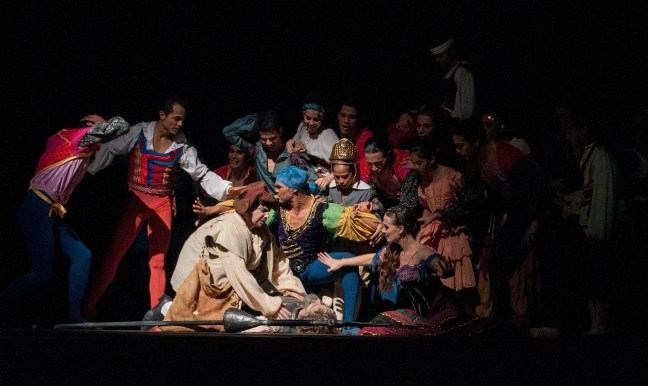
This article focusses on the use of drama-based concepts and techniques. The drama-based sessions were facilitated by Piers Ibbotson, an ex-Royal Shakespeare Company actor and associate director, now principal teaching fellow at the UK’s Warwick Business School.

The sessions explored a very wide range of drama-based concepts and experiences. This article has space to focus only on two areas: the creation of ensembles and the techniques of creative rehearsal. Delegates took part in a number of exercises to illustrate these concepts, some of which are used in theatre to help bring new groups of actors together when building new ensembles.

The focus throughout the program was on having delegates work very closely with artists, hoping to create a series of ‘ah-ha!’ moments where delegates would grasp at a physical, ‘gut’ level what the artists were experiencing and what they were trying to achieve.

Building real ensembles

Building real ensembles takes time; you cannot throw a group of people together and expect them instantly to become an ensemble. Theatre groups, however, build hugely effective ensembles remarkably quickly – there is typically a matter of weeks of rehearsal time before a new show is performed for the first time in front of an audience. The key is the actors’ mindset of trust and openness: they set out with the explicit goal of coming together as ensemble to put on a great collective performance.

In ensembles, everyone’s input is equally important – a brilliant performance by the leading actors is only possible where they are supported by brilliant performances from the rest of the cast. True ensembles are also free of status – everyone is equal before the task.

Delegates experienced a series of exercises designed to explore the ideas of status and trust in groups and the fact that it is possible to trust someone completely in the ensemble environment without it being necessary to feel that you ‘trust them with your life’.

Rehearsing creatively

The process of creative rehearsal is a key part of creating an ensemble. In theatre, a director will be ‘in charge’ of rehearsals but not ‘in control.’ Being ‘in control’ stifles creativity; directors offer ‘creative constraints’ and suggest new avenues to explore. New ideas are accepted and worked with by the ensemble before they are dropped or accepted by common consent. This is contrasted with the practice, common in business, of examining every new idea for its faults and rejecting anything that does not seem to be perfect. There is an acceptance in theatre that every idea when first put forward is ‘half baked’ and that it is the function of rehearsal to try to bake the idea fully.

Delegates took part in an improvisation exercise based on the concept of ‘yes, and…’ – taking an idea put out by one member of the ensemble, embellishing it and offering the new version back, trying not to ‘block’ the developing idea by closing down the possibility of further embellishment. Other exercises explored ‘creative leadership’ by carrying out some simple task as a group – firstly using planning and implementation and then as part of a dramatic scenario, creating the possibility for improvisation and creative leadership. When we plan and implement, any change requires that we stop, re-plan and then try to re-implement; when we work creatively together – like actors or musicians performing – we respond instantly to the changing scenario.

Another key aspect of theatrical rehearsal is that the whole cast must come together for a full rehearsal before the first performance – leading actors, supporting roles and extras. Delegates on the programme considered the extent to which business properly ‘rehearses’ scenarios creatively and whether all of the relevant players are ever brought together, or only the ‘leading actors’.

A key aspect of arts-based leadership development is that individual delegates respond differently to different sessions: a particular aspect will resonate strongly with one delegate; for another it will be something else. However, the typical take-outs from drama-based sessions on ensemble work and rehearsal were these:

Lessons from the performing arts

  • Teams do not automatically become ensembles; building an ensemble takes time and effort.
  • True ensembles are created when groups have a common challenge and work together to find the best solution.
  • Someone needs to be in charge, but not in control; the group must find their own solutions, with guidance.
  • Status must be taken out of the equation; everyone in the ensemble is equal before the task.
  • Ensembles naturally develop very high levels of trust; it is not possible to interact successfully with any element of distrust.
  • No member of the ensemble can be brilliant at anyone else’s expense, everyone has an interest in helping everyone else to be brilliant.
  • Rehearsal accepts all ideas as half-baked and seeks to fully bake them.
  • Ideas are accepted and played with in the spirit of ‘yes, and…’; no ideas are shot down in flames and the ideas that work are taken up and embellished.
  • When we work creatively together in this way, we think as we work; there is no need to stop and re-plan in the face of change.
  • For a full rehearsal, everyone involved must be in the room, including the extras.

Over the course of the four-year programme, some 200 project managers attended the week-long residential course at Oxford and a real shift towards a more ‘open-minded’ culture was reported by the company.

If businesses behaved more like artistic ensembles, business culture could be transformed.

Read the following article in this series: ‘Jazz Leadership’

A semi-fictionalised account of Dr Powell’s ground-breaking arts-based leadership programme is given in the business novel Perform To Win: Unlocking the secrets of the arts for personal and business success, by Dr Mark Powell and Jonathan Gifford

A full analysis of the dance aspect of the programme was published in the Journal of Organizational Aesthetics under the title, ‘Dancing Lessons for Leaders: Experiencing the Artistic Mindset’

Teaching Leaders To Dance

By Dr Mark Powell and Jonathan Gifford

In an earlier post, we gave a very brief account of a major arts-based leadership development programme at Oxford University’s School of Business, designed to create new behaviors in a group of senior project managers in the oil and gas exploration industry. The aim was to create a new culture of ‘open-mindedness’: the ability to form more effective working relationships with the other stakeholders involved in major capital projects and an increased ability to ‘improvise’ – to react quickly and effectively to rapidly changing situations.

Dr Mark Powell designed and ran the four-year programme, giving successive delegates an intense, week-long exposure to artists of all kinds. Mark is himself a championship-winning Latin ballroom dancer, having won the over-35 World Championship for two years running while working as a partner at KPMG. He argues that people’s core behaviours are not easily changed by new information – by ‘being told stuff’ – and that we need a gut experience, a real ‘ah-ha!’ moment of understanding, to be able to internalise something sufficiently to create enduring new behaviour patterns. Working at close quarters with top-flight performing artists has the potential to create such moments of insight. This article describes how delegates to the Oxford progamme worked with world-class competitive Latin ballroom dancers.

The connection

Sessions begin with a short routine by the dancers. Dance that looks wonderful on stage or screen has even greater impact at close quarters; the speed, agility and precision of top dancers takes the breath away. The subsequent series of exercises and demonstrations set out to give delegates some understanding of the key mindsets and approaches that dancers use to create winning performances.

In competitive dance, there is much focus on the quality of ‘the connection’ between two dancers. It comes out of their intense awareness of each other’s behavior in the course of the performance and the subtlety of their interaction.

As an exercise, delegates are asked to pair up and put their hands forward, palms facing outwards. Each delegate puts their hands against the other’s, increasing the weight transferred until it is uncomfortable for the other partner. As they ease off, there comes a point at which each partner can no longer feel the other’s weight; they have lost ‘the connection’ in a physical sense. Moving around in simple ways while trying to maintain the correct weight of connection is difficult, but tends to lead to a number of ‘ah-ha!’ moments from delegates.

Dancers are not in physical contact throughout the whole of any routine; the connection must be maintained visually. Dancers talk about ‘looking and seeing’: keeping constantly and precisely aware of what their partner is experiencing and signalling.

Discussion turns to levels of genuine interaction in the workplace. Delegates experiment with maintaining higher levels of eye contact than usual while chatting to their colleagues. This is usually slightly uncomfortable, prompting further discussion of the typical level of ‘connection’ between colleagues at work.

Using ‘the connection’ for complex improvisation

The dancers perform a short, unrehearsed routine. Dancers with good connection are able to improvise astonishingly complex routines without any prior discussion. They explain to the delegates the convention in ballroom dancing that the man ‘leads’ and so is able to initiate moves that are instantly grasped and executed by their partner, but also stress that the lead is often ‘shared’ and that the woman dancer may initiate a move. This shared leadership between expert partners enables them to improvise high-quality routines that would require hours of rehearsal by less well-connected dancers.

The dancers also show how leadership must be ‘allowed’. The physical connection that was demonstrated in the weight-sharing exercise can become ‘push-pull’. They perform a short routine in which the man ignores his partner’s responses and ‘pushes’ her around the dance floor. The effect is immediately obvious and is ugly to watch; the dance has been ruined aesthetically.

Absolute trust

The key issue of trust is dramatically demonstrated when the dancers perform a few lifts and catches. The dancers explain that the trust is actually absolute, not relative: ‘a high degree of trust’ is not good enough – a moment’s doubt and hesitation can lead, paradoxically, to accidents. Discussion turns to typical levels of trust between colleagues at work and to the advantages that higher levels of trust would bring.

 The art in what we do

Finally, the dancers explore the issue of ‘artistry’ – the aesthetic elements that raise a competitive routine above mere technical excellence. Because competition is so fierce, last year’s winning artistry will not be enough to win this year’s championship: dancers are constantly looking for the new piece of magic that will lift their routine out of the ordinary – even when the ‘ordinary’ is technically astounding. Delegates consider whether there is scope for artistry in their own performances at work.

True ensemble behavior

The common thread that runs through all performances that involve more than one person is ensemble behaviour. Groups of performing artists put on a winning performance together, or they fail. Only by helping you to perform brilliantly can I hope to be part of a winning performance.

The focus on ‘connection’ in these dance sessions helped to engender, at an emotional, gut level, a new awareness of the centrality of partnership and team work, and the fact that this depends on ‘being there for others’: reacting positively and supportively to whatever partners are experiencing and signalling in the attempt to deliver a winning performance together. Issues of ‘shared and allowed’ leadership were also key, as was the consequent ability to improvise brilliantly in the face of rapidly changing circumstances.

Embracing a ‘dance’ culture

  • Quality of connection is key: great performers react to each other in the moment, subtly and precisely
  • Great connection also enables brilliant improvisation
  • Leadership is shared, allowed and serves the overall performance
  • Trust is absolute and taken for granted; lack of trust is fatal
  • Winning performances are aesthetically wonderful as well as being technically perfect

Read the next article in this series: ‘Turning Businesses Into Ensembles’


A semi-fictionalised account of Dr Powell’s ground-breaking arts-based leadership programme is given in the business novel Perform To Win: Unlocking the secrets of the arts for personal and business success

A full analysis of the dance aspect of the programme was published in the Journal of Organizational Aesthetics under the title, ‘Dancing Lessons for Leaders: Experiencing the Artistic Mindset’

This article first appeared on CultureUniversity.com


How Business Can Learn From The Performing Arts: A Case Study

In 2011, a major oil and gas exploration company based in the UK set out on an extraordinary, arts-based leadership development programme at Oxford University’s Saïd Business School, designed and led by Dr Mark Powell. The oil and gas company’s senior project managers are responsible for multi-million-dollar exploration projects around the world and the programme was designed, not to give these senior managers enhanced skillsets or new theoretical frameworks, but to change their behaviours and mindsets – to change their culture. More specifically, the aim was to create a new culture, the key element of which could be described as ‘open-mindedness’, in two distinct forms:

  1. A heightened sensitivity to changing circumstances and the ability to react to these quickly, creatively and positively;
  2. The ability to create highly functional teams on a relatively short timescale with groups of people from different backgrounds and with differing agendas.

The results, the company confirmed at the end of the four-year project, were ‘unexpected and wonderful’.

This article gives a very brief outline of the programme and its outcomes. A short series of later posts will explore individual arts-based sessions: dance, drama, jazz and choral conducting.

It’s not the technical issues that are the problem

Major capital projects in oil and gas exploration are notoriously prone to fail to meet target in terms of either budget or schedule – arguably the inevitable consequence of using complex technologies in often physically hostile, unpredictable environments. But the company’s research showed that projects’ failure to deliver on target was due more to ‘soft’ issues, involving the ability to get the various parties involved in projects – governments, project partners, contractors – to work successfully together as a team, than it was to ‘hard’ issues – the inevitable technical problems. As the most recent client director of the programme, Rachel (not her real name) said in an interview with the authors:

 ‘We can figure out the technical side, we can solve technical issues … you know, more cost and more time will solve most problems! And from that perspective we can fix those things – but it’s not those things that are going wrong, especially on big projects.’

Rachel’s predecessor as head of the development programme, Michael (not his real name) had said something very similar in a previous interview:

‘I could see that a lot of the issues we had with projects were in relation particularly to the way that project managers behaved, both in relationship to their staff and their stakeholders. And I guess the other thing was there was no real consistency of approach, I mean they would all be quite different so there was no real strong culture that this is the way that we do it.’

A key aspect of the change in mindset that Michael wanted his managers to achieve was the ability to be sensitive to different socio-cultural environments and to be able to improvise in the face of rapidly changing circumstances:

‘Their receptiveness to new things […] for a project is important because each time these people are going out to probably different cultures, different countries, different environments. So I think having that ability to respond to what’s coming at them rather than just trying to bulldoze through, and “Well, that’s how I do it, and that’s how I’m going to do it here” [is vital].’

Exploring the techniques and mindsets of performing artists

To address these and other issues, Mark Powell proposed a radical and innovative programme at Oxford University’s Saïd Business School, giving delegates an intense, week-long exposure to artists of all kinds: actors, jazz musicians, dancers, singers, conductors, poets, storytellers and painters. Mark, an associate fellow of the business school, is a strategy consultant who has been a partner at both KPMG and A.T. Kearney, in addition to running several start-up businesses. Mark is also a World Championship-winning Latin ballroom dancer, having won more than 50 titles over the course of a dancing career that began when he was a student of economics at Cambridge University and continued through his career as a management consultant.

As Mark says,

‘I realized that the way of working together that my dance partner and I used to deliver championship-winning performances was different from the kind of relationship that I had with my business partners, or the kinds of relationship that I saw in the companies I was consulting for. I also realized that the way that we worked together as a dance partnership could be broken down and analysed. And the more I worked with other artists – actors, conductors, jazz musicians – the more I realized that we were all using very similar techniques and mindsets and that these could be communicated to other people and used very effectively in the world of business and even in everyday life.’

Changing behaviors with ‘aha!’ moments of gut understanding

Key to Mark’s coaching approach is the belief that offering people new ideas in the form of information – ‘telling people things’ – is very unlikely to change their behavior. But when they experience something at a gut, emotional level, this can bring about a real and permanent change to the way that they see things and the way that they behave.

‘When people work closely with really great performing artists – dancers, singers, conductors, jazz musicians, whatever – they experience something,’ says Mark. ‘It’s very moving, it’s very powerful, so it gets beneath people’s intellectual defences and then, typically, they really ‘get’ something. They really see how two dancers ‘connect’ – how they watch each other intently and pick up tiny bodily cues that allow them to move together, at speed, in an apparently magical way. Or they really ‘get’ how jazz musicians allow leadership to move around the group without any apparent signals, or how a choir and a conductor create a uniquely affecting performance of a piece of music, based only on the choir’s instinctive interpretation of the conductor’s body language. And when that wonderful ‘aha!’ moment happens, it never leaves you. So these people go back to their world with a different view of how you can work creatively with someone; how you can develop this real ‘ensemble’ approach of “We’re going to work together to make this a winning performance, and I have to help you to be brilliant to enable me to be brilliant.”’

The programme had not been easy to ‘sell’ to senior figures in the corporation. As programme director, Michael, told the authors:

‘I guess the sort of standard project management course would have been, you know, do the cost estimating and schedule risk management. And there was an awful lot of pressure from certain parts of the company to do that, that this should be just a skills training programme.’

But as Rachel confirmed:

‘I think there is an intuitive understanding at a lot of senior levels that in order to get extraordinary results you need to do something extraordinary, and getting people outside of their comfort zones and getting people to try something that is extraordinarily unusual for them is where we got the best realizations from those people about their own environment, their own behavior, their own transactions and relations with others.’

Ten behavioural lessons from the performing arts

The ‘take-outs’ from this kind of intense and varied programme of arts-related coaching are highly varied and differ between the forms of performing arts involved and from individual to individual. The main take-outs from the programme can be summarised in the form of 10 questions.

  • What performance are we in and what is our role?
  • Where is our theatre of action?
  • Have we built a trusting, connected, partnership or ensemble?
  • Are we rehearsing creatively?
  • Do we have the right people in the room?
  • Do we know what inputs are creating our outputs?
  • Where is the art in what we do?
  • Is our leadership shared, allowed and inspirational?
  • Are we helping each other to perform brilliantly?
  • Are we delivering a winning performance?

The programme director, Michael, confirmed that delegates had indeed acquired a greater self-awareness of their own leadership style and behavior:

‘A lot of them work very hard, there’s a lot of energy, and they don’t necessarily ever step back and look at their impact and how they appear to others. Whereas in a lot of these sessions it did make them reflect on it and think well, that’s how I behave and that’s how I come across. So there was quite a lot of that in the sessions, people were forced to just reflect and think and experience in a different way. And it did have an impact on some of them. Particularly the more difficult characters […] Probably the two most disruptive in the whole population did, in the end, turn out to be those two that were most supportive of the whole thing.’

A very real financial “oomph”

A culture of increased ‘open-mindedness’ did develop amongst the project managers who had attended the programme, leading to greatly improved relationships with their complex teams of stakeholders, and several individual initiatives in problem-solving that saved the company considerable amounts of time and money.

To give Rachel the last word on the arts-based programme’s effect on delegates:

‘It was completely unexpected and far greater than we had anticipated […] A lot of the perception before that was that the benefits [would be] more intangible; that the benefits were more soft and fuzzy and fluffy […] and what we found when we actually got this back is that’s not actually the case at all and that the results that were coming back were much more concrete and much more distinct than we expected – there was a very real financial oomph.

Read more about what business can learn from the arts in a series of four additional posts, beginning with Developing a Performance Culture.


A semi-fictionalised account of Dr Powell’s ground-breaking arts-based leadership programme is given in the business novel Perform To Win: Unlocking the secrets of the arts for personal and business success.

A full account of the dance-related Dr Powell’s ground-breaking programme was published in the Journal of Organizational Aesthetics.